
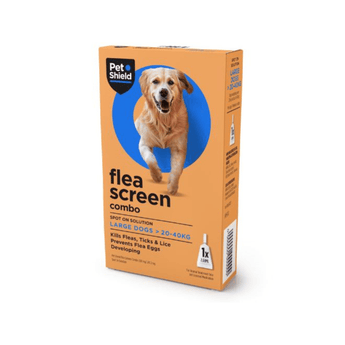


Pet Shield Flea Screen Combo - Large Dog
Couldn't load pickup availability
FleaScreen Combo Spot-on Solution - Large dogs weighing 20-40kg
FleaScreen Combo Spot-on Solution for Dogs kills fleas on treated dogs and prevents eggs laid by fleas exposed to FleaScreen Combo from developing for up to 8 weeks. Kills ticks on treated dogs for up to 4 weeks and treats infestations of biting lice.
FleaScreen Combo is a spot-on treatment that is applied between the shoulder blades. It is suitable for use in households on both cats and dogs.
Also available for:
Small dogs weighing 2-10kg
Medium dogs weighing 10-20kg
Warnings
Only use FleaScreen Combo for dogs if your dog is aged 8 weeks or older, and weighs more than 2kg. Do not use if your dog is sick or recovering from an illness. Do not use if your dog has a hypersensitivity to the active ingredients or any of the ingredients. Do not apply on wounded or damaged skin. Do not use FleaScreen Combo for Dogs on cats or ferrets. Do not use on rabbits, as adverse reactions including death can occur.
Treating for Fleas
For optimum flea control, all animals in the house should be treated with a suitable flea treatment, ideally every 4 weeks. Continuous regular treatments help prevent adult fleas infesting your pet and their eggs being distributed throughout the house. Fleas from cats and dogs can infest the animal’s bedding or other areas in the house where they often go. Regular vacuuming and the use of a suitable household spray may be needed if there is a heavy infestation. Controlling fleas is only part of protecting your pet and your family against harmful parasites. Provide your pet with effective flea and worm treatments regularly, to combat external parasites such as fleas and internal parasites like the roundworm Toxocara canis that can be passed to humans. Regular treatments help break the lifecycles of these parasites, helping to keep your pet and your family healthy and pest free.
Applying Flea Treatment
Always use as directed. Before use, read the package leaflet for full instructions and all warnings, including user warnings. Hold the pipette in an upright position, twist and pull the cap off. Turn the cap around and place the other end of the cap back on the pipette. Push and twist the cap to break the seal, then remove the cap from the pipette. Part the coat on the back of the animal at the base of the neck in front of the shoulder blades until the skin is visible. Place the tip of the pipette onto the skin and squeeze the pipette several times to empty its contents completely and directly onto the skin in one spot.
Do not reapply more often than at four weekly intervals. It is important to make sure that the product is applied to an area where the animal cannot lick it off and to make sure that animals do not lick each other following treatment.
PDSA Vet Advice
This product will treat fleas, ticks and lice that live on your pet! Just make sure you apply it to your pets skin on the back of their neck (where they can't reach) every 4 weeks and don't bathe your pet for a few days afterwards, so it doesn't wash off. Remember, 50 fleas on your pet can mean up to a thousand fleas or eggs in your house! So for best results make sure to treat your home too, using a flea house spray.
Be Spot-on Aware
Flea and tick spot-ons are an important way to protect your pet’s health
but how you use them really matters. The way these medicines are applied can
affect how well they work and whether they end up in our waterways and wider environment
Plan – Apply – Protect
Plan – if you need to wash your pet then do it the days before applying medicine, rather than afterwards
Apply – Read the product instructions or visit the Veterinary Medicines Directorate Product Information Database to understand how to apply it right. Part your pet’s fur at the application site(s) until you can see the skin, apply directly to the skin not the fur.
Protect
- Don’t touch the application site until its dry.
- Don’t let your pet swim for at least 4 days after application.
- Try to limit swimming and washing of your pet in the weeks
after application. - Bin used pipettes – don’t rinse them down the sink or recycle.
- Put pet fur from treated animals in the bin, don’t leave it out for nesting birds.
Buying Products Safely
Always buy flea and tick treatments from a reputable source such as your vet, an SQP-registered retailer, a registered online pharmacy, or a pet shop retailer, etc. The VMD has published a list of registered online retailers, which contains all sellers permitted to sell
‘behind-the-counter’ or prescription-only medicines.
Counterfeit and unlicensed products do exist and may not work as intended or could harm your pet. If a product seems unusually cheap or arrives without proper packaging and labelling, treat this as a warning sign.
Keeping your Dog flea free
Spot-on Flea Solutions for Dogs
Spot-on flea treatments can help protect dogs against fleas, ticks and lice, particularly if they spend time outdoors or regularly come into contact with other animals. They’re commonly used as part of a regular parasite treatment routine to help keep dogs protected and help prevent flea infestations in the home.
Available in an easy-to-apply pipette, spot-on flea treatments are applied directly to your dog’s skin, usually between the shoulder blades where they can’t lick it away.
How Spot-on Flea Treatments Support Dogs
These parasite treatments are designed to help protect dogs by:
- Treating fleas on your dog
- Helping control ticks and biting lice
- Helping prevent flea eggs developing in the home
Some products also help break the flea life cycle, helping reduce flea eggs and larvae in the home when used regularly.
Common Ingredients in Spot-on Flea Treatments
Many spot-on flea treatments for dogs include ingredients such as:
- Fipronil to help treat fleas and ticks
- S-Methoprene to help prevent flea eggs developing
- Carrier ingredients that help spread the treatment across the skin
Different products contain different ingredients, and not all flea treatments will be suitable for every dog.
When to Consider a Spot-on Flea Treatment
Spot-on flea treatments may be helpful for:
- Dogs that go outdoors regularly
- Homes with ongoing flea problems
- Dogs living with other pets
- Regular flea prevention as part of routine pet care
Important to Know
Spot-on flea treatments should only be used as directed and are not suitable for all pets. Only use on dogs over 8 weeks of age and weighing more than 2kg. Do not apply to damaged skin or use on sick or recovering animals. It is important to prevent pets licking the treatment after application and to avoid bathing or swimming for at least 48 hours after use. Regular vacuuming and treatment of the home may also be needed during a flea infestation.


